
What is email warmup?
Short answer: Email warm-up is the practice of gradually increasing wanted email from a new or inactive sending domain or IP address so mailbox providers can learn how you send and how recipients respond.
Many tools sold today as "email warmup" do something different: they connect your mailbox to a network of other mailboxes that exchange messages, open them, reply, and mark them "not spam".
The messages are real, but the engagement is fake. This is called synthetic warming, and deliverability and anti-abuse organizations advise against it.
Two practices, one name
Traditional warm-up gradually increases the volume of real email to people who want it, starting with your most engaged recipients. It helps mailbox providers learn what to expect from your sending. It's a phase, and it ends.
Synthetic warming uses networks of mailboxes to generate fake engagement. These accounts exchange messages, reply to each other, and rescue messages from spam. It's usually sold as an ongoing subscription.
The difference is more than technique. Traditional warm-up shows mailbox providers how your actual audience responds. Synthetic warming feeds them fake engagement from a network of mailboxes.
One builds reputation through real sending. The other attempts to manufacture evidence of it.
What warm-up is actually for
Mailbox providers like Gmail, Yahoo, and Microsoft are cautious with unfamiliar senders. Bad actors can create new domains cheaply, so a new domain starts with little sending history. Gradually increasing volume gives providers time to learn who you are, who you're sending to, and how those people respond.
Steve Atkins of Word to the Wise describes warm-up as an introduction rather than something that heats up. Mailgun makes a similar point: warm-up gives providers a representative sample of how you send. Google's guidelines recommend starting with engaged recipients, increasing gradually, and monitoring the results.
Representative is the key word. Warm-up works by being representative of your real sending.
Your most engaged subscribers aren't necessarily representative of your entire list, but they are part of your actual audience. They've chosen to receive your email, and their responses are real. That's fundamentally different from exchanging messages with other mailboxes whose purpose is to generate positive signals.
Warm-up isn't about collecting enough positive engagement to unlock the inbox. It's about establishing a sending pattern that reflects what you'll continue doing.
How the term got inverted
The language made the shift surprisingly easy.
"Warm" was always a loose metaphor for what is essentially an introduction. Add its proximity to "cold email," and warmup starts to sound like the natural step between cold outreach and successful delivery. In sales, warm leads and warm introductions mean familiarity. A network of friendly conversations can seem like a logical way to warm up a mailbox.
But fake conversations don't make your eventual recipients any more familiar with you.
Many warmup vendors now describe the process as gradually increasing volume and generating engagement through other mailboxes. Some recommend running these services indefinitely. Mailgun notes that "email warm-up" increasingly refers to services using fake accounts to trick mailbox providers into trusting senders, a practice it calls unethical.
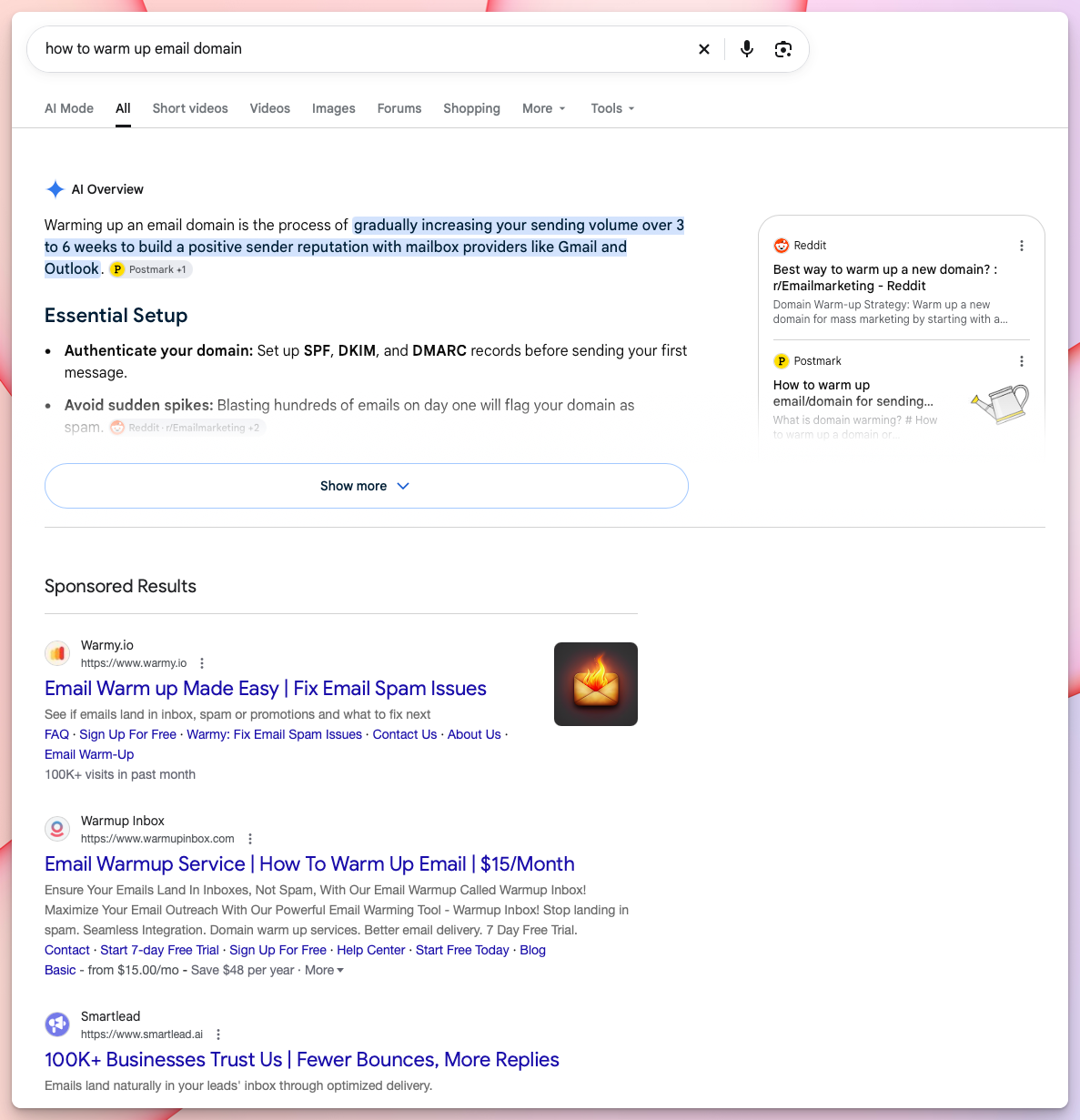
The shift is visible in search results. In an October 2026 Google search for "email warmup," every ad and eight of nine page-one organic results came from warmup vendors or cold outreach platforms. Google's AI Overview described fake engagement as part of how warmup works, even though Google's own sender guidelines say nothing of the kind.
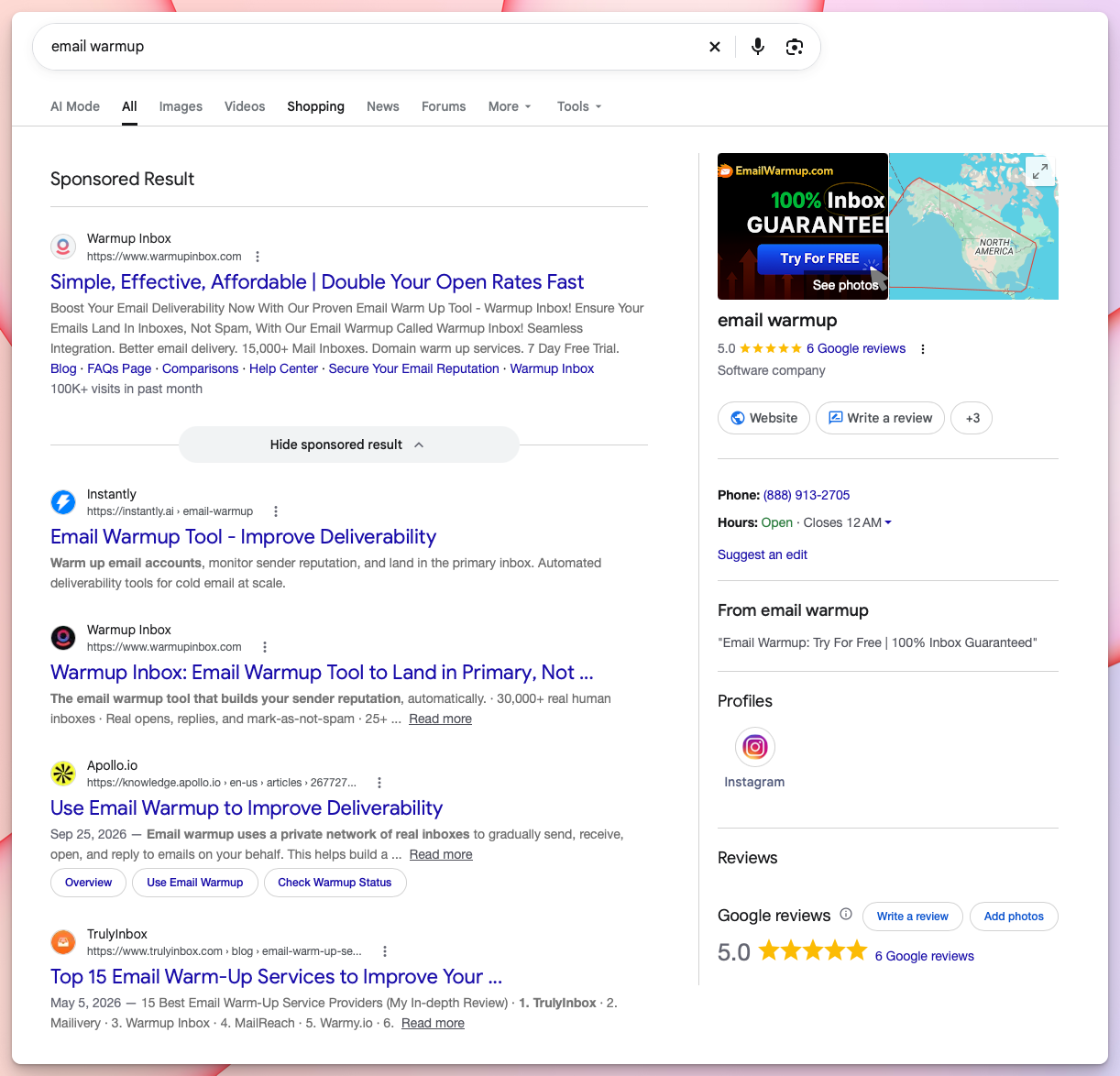
Searching "how to warm up email domain" instead returned guidance from Postmark, Mailgun, and Microsoft, with a mix of content from paid warm-up tools. A small tweak can change the answers being presented.
The search results don't establish what most senders believe, but they help explain why someone looking for legitimate warm-up instructions might encounter fake engagement tools first.
Why fake engagement can backfire
It isn't representative. Engagement from a warming network has little to do with the people you actually email. Mailgun warns that a sudden drop from high engagement during warm-up to lower engagement on real messages can itself raise suspicion. Mailbox providers look for consistency over time.
You can fake engagement. You can't manufacture consent.
A network of mailboxes can open your messages, reply to them, and mark them "not spam", but none of that changes whether your actual recipients asked for your email, want to receive it, or will mark it as spam when it arrives.
Even when people have opted in, you can't control how they'll respond. Someone who subscribed months ago may no longer be interested. Fake engagement can't tell you whether your real audience still wants to hear from you.
Atkins points out that warm-up only works for mail people want. If the email isn't wanted, a careful introduction just helps the filter recognize that more quickly.
It creates false confidence. A dashboard full of positive replies and successful deliveries from a warming network doesn't tell you whether your actual email will reach interested recipients. Meanwhile, problems with your contact lists, content, or sending practices can go unaddressed.
It introduces additional risks. Many services need permission to send, read, and move messages inside your mailbox, potentially including client correspondence. And fake engagement itself can now affect your reputation.
In September 2026, Validity launched Heatwave, a blocklist targeting domains showing signs of synthetic warming. More than a million domains were listed at launch, and the information is available to Validity's mailbox and security partners.
Spamhaus also strongly discourages commercial warm-up services designed to bypass spam filters by artificially inflating engagement.
Who actually needs warm-up?
Not every sender needs a warm-up program.
A gradual start makes sense when you're sending substantial volumes from a new domain, moving to a dedicated IP address, resuming sending after a long break, or making a major increase in volume.
But if you're sending ordinary business correspondence from an established domain, you don't need a special warm-up schedule. Normal, consistent sending is how that domain maintains its reputation.
The same applies to someone starting a new business mailbox and sending a handful of expected messages each day. There's no need to manufacture conversations before communicating with real contacts.
If you use an email service provider's shared IP addresses, the provider manages the reputation of that sending infrastructure. Your domain may still benefit from a gradual start, especially if you're launching a substantial email program.
How to warm up the right way
- Authenticate first. Configure SPF, DKIM, and DMARC correctly, including alignment with your From domain.
- Start with engaged recipients. Send to people who have recently clicked, replied, purchased, or otherwise shown interest. Don't rely on opens alone, since privacy features make them unreliable.
- Increase gradually. Avoid sudden spikes, and send the types of email you intend to keep sending. If you're launching a newsletter, warm up with that newsletter, not unrelated messages designed to generate replies.
- Watch the results. Monitor bounces, delivery failures, and complaints. Google Postmaster Tools can provide additional information for senders with enough traffic to personal Gmail accounts. Slow down if problems increase.
- Then stop calling it warm-up. Once you're sending at your intended volume, the introduction is over. Maintaining your reputation is part of ordinary email operations.
There's no universal schedule. A small program may reach full volume within a week or two, while a large one can take several weeks. Let the results determine the pace.
Already using a warmup service?
Turn off the fake engagement and revoke the service's access to your mailbox. Check whether your domain appears on Validity's Heatwave lookup.
Then focus on your actual email. Are messages reaching people who expect them? Are there authentication errors, bounces, or complaints? Those answers matter more than the engagement reported by a warming network.
Our recovery guide explains how to investigate and address reputation problems without buying another service promising to warm up your mailbox.
Frequently asked questions
Can warm-up repair a damaged sender reputation?
Not by itself. A damaged reputation needs its underlying cause addressed first, whether that's unwanted email, poor list quality, authentication problems, or sudden changes in sending behavior. Gradual sending may be part of recovery, but it isn't a substitute for fixing the problem.
Is asking colleagues to open and reply a safe way to warm up?
Staged engagement from people who aren't your audience still isn't representative. Asking genuine contacts to check whether expected messages arrived is different: that's real feedback on real email.
Legitimate seed testing is also different. Sending test messages to check authentication, rendering, or inbox placement isn't the same as faking interest to influence reputation.
Is a warmup tool ever useful?
Tools that gradually increase the volume of your real email can be useful. Many email service providers offer automated warm-up for dedicated IP addresses. That's different from a network that generates fake engagement.